
Recently I switched from using a roux (50/50 mixture of flour and butter) as a…
Knives
 Your Chef’s Knife is an extension of your hand. It should do it’s job effortlessly and well. The last thing you want to be doing is struggling with your knife. If should be a pleasure to use. It is also one of the places you should be willing to spend a little extra money.
Carbon Steel Blades
My grandfather was a blacksmith. He made knives. I have one that he gave to my mother shortly before is death. She passed it down to me, and soon I will pass it on to my son. It’s blade is carbon steel. Carbon steel is easily sharpened, but it also easily dulls.
Carbon steel knives have two disadvantages. The first is that they rust. After each use you need to clean and oil them. The before each use you need to wipe the oil off. If you don’t do that you’ll end up with rust stains on the edges of everything you cut.
The second disadvantage of old-fashioned carbon steel knives is that they tend to leave a dark residue on the edges of everything you cut. Try cutting some lettuce. You’ll see that the cut edge is dark. That dark stain comes from the knife’s blade. It’s probably OK at home but in a commercial environment the health inspector will shut you down if he sees that.
Having said that, the blade of a carbon-steel knife is flexible, which makes it ideal for cutting and carving.
Stainless Steel Blades
Stainless steel knives are popular because they eliminate the rusting and staining you get with carbon steel knives. The are however, very hard. One problem with this hardness is that they are more difficult to sharpen. Another is that stainless steel blades are very stiff. Most professional chefs prefer a knife blade with more flexibility.
High Carbon Steel Knives
Today the preferred material for chef’s knives is High Carbon Steel. It has all the advantages of carbon steel and stainless steel:
- It doesn’t rust
- Sharpens easily
- Doesn’t leave marks on cut edges
- Flexible
All the high-end knife manufacturers now produce there knives with high carbon steel blades. Look for blades that say “high carbon steel” and/or “no-stain”.
What to Look For In A Chef’s Knife
- Look for a high carbon steel blade.
- Look for a blade that that is integral to the handle, meaning the steel doesn’t stop where the handle starts. In other words there is one solid piece of steel from the tip of the blade to the heal of the handle
There are knives that meet those qualifications that cost $200. There are also knives that meet those qualifications that cost $15. What’s the difference?
- The balance
- Shape of the handle
- The handle material
- The method of attaching the handle pieces to the steel
- How the knife feels in your hand.
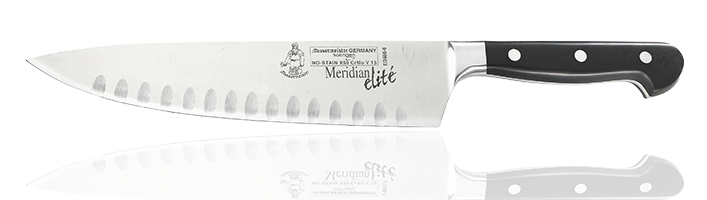
My chef’s knife is the Messermeister Meridian Elite in the photo at the top of this article.
 Kullenschliff
Those shallow hollow-ground indentations you see along the blade of some knives is called kallenschliff. In Japanese knifes that are referred to as granton, and helpful when using the knife for slicing to keep the slices from sticking to the blade.

Related Posts


This Post Has 0 Comments